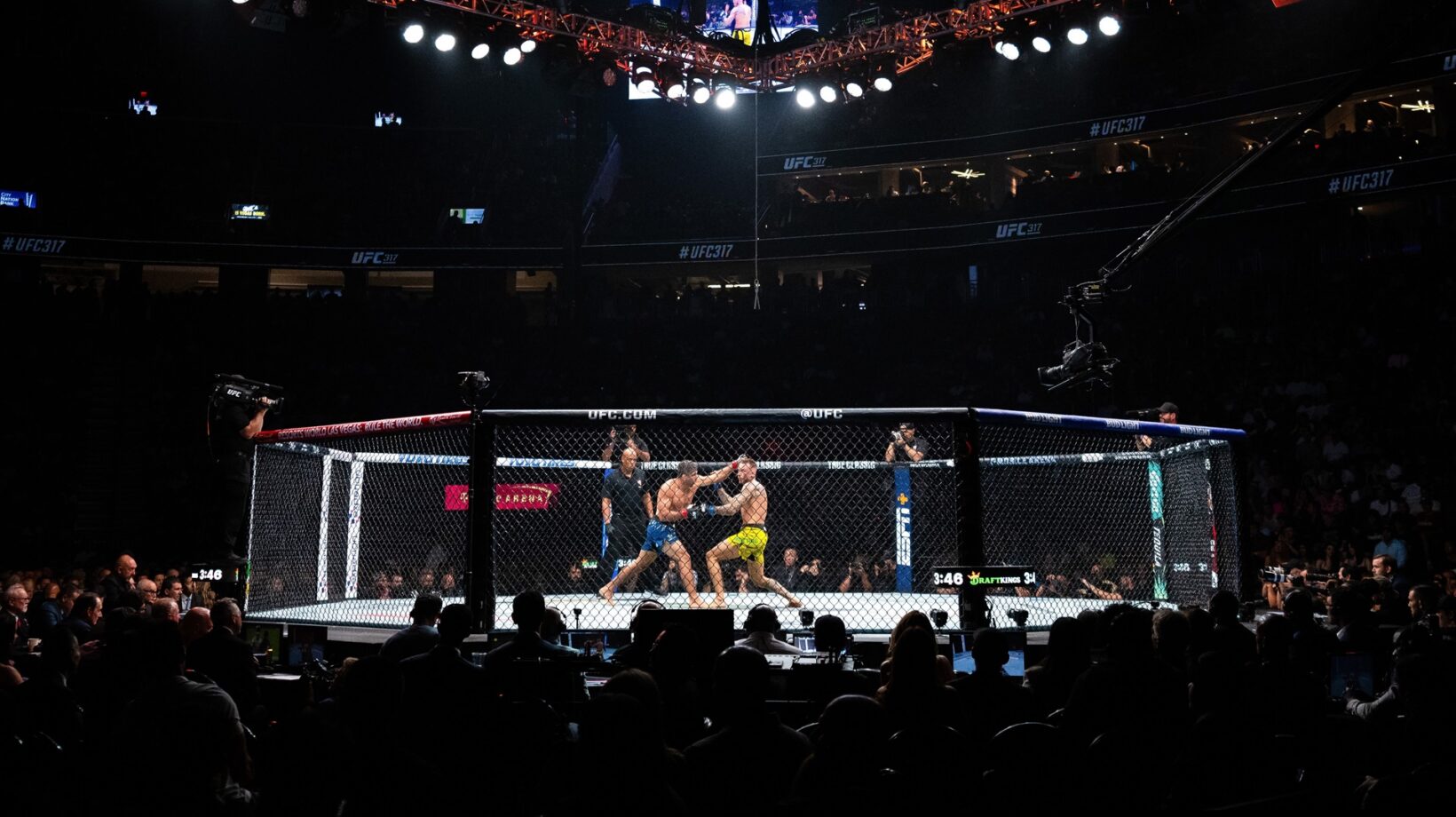
Watch any UFC event – whether it’s a title bout headlining a numbered event or the prelims of a UFC Fight Night – and one thing defines the experience before a single punch is thrown: the Octagon®. The eight-sided structure is one of the most recognizable designs in sports, a competitive space so iconic that fans refer to it simply as “The Octagon.”
For fans of UFC on Paramount+, UFC-curious readers, or anyone getting ready for a big card, understanding UFC’s Octagon and the Octagon rules, and the logic behind its design makes the sport easier to follow. From the Octagon dimensions to scoring, fouls, and judging – here are the five essential things to know.
1. It’s a protected brand and a unique structure
The Octagon is a unique structure and a protected brand. The registered trademark and trade dress are owned by Zuffa, LLC, the parent company of UFC.
The fence, canvas, padding, posts, and platform height are also all part of UFC’s protected Octagon system. Everything from the vinyl-coated chain-link fencing to the matte-blue canvas is defined, patented, and licensed.
The origin of the Octagon design goes back to the earliest days of the organization. The shape wasn’t just chosen for aesthetics – it was built around visibility, fighter safety, and a clear, unobstructed view for both spectators and broadcast cameras. Straight lines reduce corner traps, the angles give fighters more room to circle and cut off space, and the dimensions prevent competitors from being pinned too against the fence easily.
2. Dimensions and construction of the Octagon
UFC events use two official Octagon sizes, each with specific dimensions and construction: standard and small.
Standard Octagon
- Diameter: 30 feet
- Area: 750 square feet
- Fence Height: 6 feet
- Platform Height: 4 feet off the ground
- Fence Material: Vinyl-coated chain-link fencing
- Canvas & padding: 1 to 2-inch foam beneath the canvas, with padded corners and posts
Small Octagon
- Diameter: 25 feet
- Area: 518 square feet
- Same fence height, materials, and platform style as the Standard Octagon
The materials aren’t aesthetic choices – they’re functional. The vinyl coating prevents cuts. The foam underlay reduces the impact of takedowns. The elevated platform helps improve visibility for fans and allows TV cameras to capture clean angles.
3. The rules inside the Octagon
The Octagon isn’t just a structure. It’s where the Unified Rules of Mixed Martial Arts – developed by the Association of Boxing Commissions and enforced at all UFC events – govern everything from legal techniques to fouls to judging criteria.
Bout structure & weight classes
UFC bouts follow a consistent format:
- three 5-minute rounds for non-title fights;
- five 5-minute rounds for championship fights, all main events and select featured bouts on a main card;
- and 1-minute rest periods between rounds
UFC features multiple weight classes across both men’s and women’s divisions, each with strict limits and specific championship categories.
Legal vs. illegal techniques: top common fouls
Some techniques that are considered fouls in the Octagon are:
- eye-gouging
- grabbing the fence
- kneeing the head of a grounded opponent
- headbutts
- groin strikes
- strikes to the back of the head
Competitors are also prohibited from hair-pulling, small-joint manipulation (like finger bending), and holding shorts or gloves. Repeated or dangerous fouls can lead to point deductions, disqualification, or no contest rulings.
Judging & scoring
Rounds are judged and scored using the 10-point must system – the winner of the round gets 10 points; the other fighter gets 9 or less. Judges prioritize the following when deciding their score for a fighter:
- Effective striking and grappling (meaningful impact matters most)
- Aggression
- Fighting-area control
A 10-8 round occurs when one fighter shows dominance in offensive output or control.
4. Size matters: standard vs. smaller Octagon
UFC events sometimes opt for the smaller (25-foot) Octagon for practical reasons – smaller venues, production constraints, or specific layouts that can’t accommodate the full 30-foot structure.
But that smaller Octagon isn’t just a space saver. It changes the fight.
Less space can lead to:
- faster pace
- more pressure-based exchanges
- increased clinch work and grappling opportunities
- more finishes (historically and anecdotally)
The smaller Octagon reduces total area by nearly 232 square feet, giving aggressive fighters less room to be avoided. Strikers who rely on lateral movement feel it immediately. Wrestlers and pressure fighters benefit from the tighter angles.
Standard vs. Small Octagon at a glance
| Feature | Standard (30 ft) | Small (25 ft) | Impact |
| Diameter | 30 ft | 25 ft | Less space = more action |
| Area | 750 sq ft | 518 sq ft | Smaller footprint increases exchanges |
| Pace | Moderate–high | High | Pressure fighters thrive |
| Movement | More lateral | Limited | Strikers must adjust angles |
5. Common misconceptions about the Octagon
“It’s just an eight-sided platform.”
It goes far beyond the shape. The Octagon’s fencing, padding, angle geometry, and platform height create unique movement patterns. There’s a reason UFC maintains exclusive rights to the design – it’s engineered specifically for MMA, not adapted from boxing.
“Judges only count strikes.”
They don’t. Scoring evaluates damage, impact, effective grappling, aggression, and control – in that order.
“The Octagon is the same size at every event.”
Nope. UFC alternates between the standard and small versions depending on the venue.
Bonus: frequently asked questions, answered
How big is the Octagon?
The standard UFC Octagon is about 30 feet in diameter with 750 sq ft of fighting space. The smaller version is 25 feet in diameter with 518 sq ft.
Can you grab the fence?
No, you cannot grab the fence. It’s a foul. Grabbing the fence can prevent takedowns or positional changes and may trigger a point deduction.
Why do some events look different?
Some events look different because they use the smaller Octagon, which tightens the action and changes pacing.
What makes a fighter “grounded” in the Octagon?
Under the Unified Rules of MMA, a grounded fighter is defined by having anything other than the soles of their feet or both hands on the canvas – a hip, thigh, knee or elbow qualifies.
How can I watch UFC in 2026?
In 2026, every UFC event streams live and on demand on Paramount+. For dates and times of all upcoming events, get the UFC schedule 2026.

UFC on Paramount+
Watch Now